51/Flux Resource Allocation Protocol Extensions
This specification describes optional extensions of the Flux Resource Allocation Protocol Version 1 (RFC 27).
Name |
github.com/flux-framework/rfc/spec_51.rst |
Editor |
Dominik Huber <domi.huber@tum.de> |
State |
raw |
Language
The key words “MUST”, “MUST NOT”, “REQUIRED”, “SHALL”, “SHALL NOT”, “SHOULD”, “SHOULD NOT”, “RECOMMENDED”, “MAY”, and “OPTIONAL” in this document are to be interpreted as described in RFC 2119.
Background
Flux Resource Allocation Protocol Version 1 (RFC 27) describes scheduler RPCs for static resource allocation. This RFC describes optional extensions to support dynamic resource allocations.
Dynamic Resource Management (DRM) allows dynamic changes to a job’s resource allocation during runtime. Such changes are achieved through dynamic reallocation operations, (i.e. modifications of the Flux Resource Set such as adding and/or removing resources). To coordinate such dynamic reallocation operations, a communication mechanism between jobs and schedulers involving the shell and job manager is required.
This covers both, malleable and evolving jobs, through a unified mechanism.
The communication mechanism defined in this RFC is based on the
PMIx_Allocation_request [1] and is therefore not supported by the PMI-1
wire protocol.
Conceptually, the envisioned mechanism consists of these steps:
1. Dynamic allocation request: Jobs indicate support for dynamic reallocation operations towards the scheduler. For simplicity, we refer to this as dynamic allocation request, although it more generally describes a space of possible reallocation actions supported by the job (e.g. supported range of number of resources, supported resource types, …) coupled with optimization information (e.g. performance models, urgency, …).
Note
TODO: The representation of optimization information might be specified in a separate RFC
2. Dynamic allocation response: The scheduler eventually responds with a concrete reconfiguration decision towards jobs, which lies within the constraints specified in the request.
3. Resource release: Resource release requires an additional step, in which jobs explicitly release resources back to the system.
While this RFC focuses on the interaction between job manager and scheduler, DRM also requires interactions between jobs, the shell, and the job manager. Therefore, in the following paragraph we provide broader context of the realization of dynamic reallocation operations within Flux.
In this context, the Flux job shell provides the job-local execution and control context through which processes running in a Flux job interact with the Flux runtime. It hosts job-facing interfaces (possibly through the PMIx plugin) and translates or forwards dynamic allocation messages between the application and the Flux job manager.
In addition to it’s role managing state transitions as indicated in RFC 27, the Flux job manager now also mediates dynamic allocation requests.
A Flux scheduler’s role is passively processing dynamic resource allocation messages sent by the job manager on behalf of jobs.
A high-level overview is provided in the following figure.
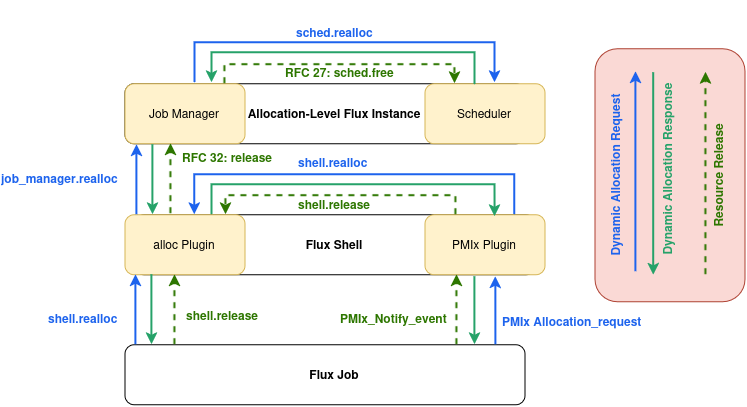
Overview of dynamic allocation communication.
A Flux Job triggers a dynamic reallocation through a) the PMIx plugin with a
PMIx_Allocation_request which sends a dynamic allocation request to the shell’s
alloc plugin with a shell.realloc request, or b) directly through a
shell.realloc request.
The Flux shell sends a dynamic reallocation request to the local job manager
with a job_manager.realloc request. The job manager then forwards the
request on behalf of the Flux shell to the local scheduler with a
sched.realloc request.
A simple scheduler satisfies sched.realloc requests by the
first-in-first-out principle.
More complex schedulers MAY consider multiple sched.realloc requests
and process them out of order to prioritize or balance measures of success
such as resource utilization or fairness.
Schedulers who do not support DRM SHALL respond with the UNSUPPORTED type.
The response from the scheduler contains a concrete reallocation action to adapt a job’s resource set and is processed by the job manager by applying required changes to the job. This includes adding any additionally provided resources to the job’s resource set and sending a response for the outstanding dynamic allocation request to the shell.
The response from the job manager is processed by the shell by applying required changes to the job runtime environment. This includes sending a response for the outstanding dynamic allocation request to the job or PMIx plugin.
Since removing resources requires prior adaptation of the job (such as
terminating processes on the indicated resources), the actual release of
resources from a job’s resource set is deferred until explicitly released
by the job with a shell.release.
When the shell receives a shell.release and corresponding job and shell
processes have terminated, the job execution service responds with a
release response (with final=false) to the streaming RPC defined in
RFC 32 to release resources back to the job manager.
The job manager then releases resources back to the scheduler with a
sched.free call as defined in RFC 27.
Abstract, dynamic resource allocation requests are expressed as a jobspec object (RFC 25 or later). Concrete resource assignments are expressed as an R object (RFC 20 or later). These objects are stored in the KVS per the job schema (RFC 16).
When adding or removing resources to/from a job’s allocation, the Flux job
manager SHALL emit corresponding job lifecycle events such as alloc,
resource-update, release, and free (RFC 21).
This RFC describes the RPC messages related to the job manager <-> scheduler interaction.
Note
TODO: Where should we describe the remaining RPCs?
Design Criteria
Enable optional support for dynamic (malleable and evolving) allocations
Ensure compatibility with the
PMIx_Allocation_request
Implementation
Realloc
The job manager SHALL send a sched.realloc request when
receiving a realloc request from a shell.
The request payload consists of a JSON object with the following REQUIRED keys:
- job id
(integer) ID of the job this request relates to
AT LEAST ONE of the following two keys is REQUIRED:
- spec_add
(object) jobspec object (RFC 25 or later) matching resources to be added
- spec_sub
(object) jobspec object (RFC 25 or later) matching a subset of job resources to be removed.
The following key is OPTIONAL:
- R
(object) R object (RFC 20 or later) referencing a certain set of resources this request applies to.
Example for a REALLOC request forwarded by the job manager to the scheduler to support the addition of four nodes with two cores each:
{
   "job_id": 42,
   "spec_add": {
      "version": 1,
      "resources": [
         {
            "type": "node",
            "count": 4,
            "with": [
               {
                  "type": "slot",
                  "count": 1,
                  "label": "default",
                  "with": [
                     {
                        "type": "core",
                        "count": 2
                     }
                  ]
               }
            ]
         }
      ],
      "tasks": [
         {
            "command": ["app"],
            "slot": "default",
            "count": {
               "per_slot": 1
            }
         }
      ],
      "attributes": {
         "system": {
            "duration": 3600.0,
            "cwd": "/home/flux",
            "environment": {
               "HOME": "/home/flux"
            }
         }
      }
   }
}
The response payload is a JSON object with the following REQUIRED keys:
- alloc_id
(integer) Unique ID assigned to this request by the scheduler
- type
(integer) response type in the range of 0 through 3
There are three response types:
- SUCCESS (0)
Scheduler has decided on a resource reallocation action
- DENY (1)
The scheduler decided to not consider this realloc request
- CANCEL (2)
The realloc request was canceled by a
sched.cancelrequest- UNSUPPORTED (3)
Realloc requests are not supported. Schedulers who do not support DRM SHALL immediately respond with the UNSUPPORTED type.
If response type is SUCCESS, at least one of the following additional keys is REQUIRED:
- R_delta_add
(object) R object (RFC 20 or later) describing resources to be added
- R_delta_sub
(object) R object (RFC 20 or later) describing resources to be removed
If resources are to be removed, the Flux job manager SHALL wait until the job
execution service sends a <service>.release, after which it SHALL send
one or more sched.free requests to release allocated resources to the
scheduler (RFC 27).
Example of a SUCCESS response for a REALLOC request:
{
    "alloc_id": 12321234,
    "type": 0,
    "R_delta_add": {
       "version": 1,
       "execution": {
          "R_lite": [
             {
                "rank": "19-22",
                "children": {
                   "core": "0-47",
                   "gpu": "0-7"
                }
             }
          ],
          "nodelist": [
             "node[186-189]"
          ],
          "nslots": 32,
          "starttime": 1676560542,
          "expiration": 1676562342
       }
    }
}
Realloc Cancel
The job manager MAY send a sched.realloc_cancel request to cancel a sched.realloc
request, as described in RFC 6.
- matchtag
(integer, REQUIRED) The matchtag of the request to be canceled.